> PROJECT:
[COORDINATES]: 39.92° N, 116.43° E
[ARCHITECT]: Zaha Hadid Architects
[COMPLETION]: 2012
Welcome to the interface of the future. You are viewing a digital deconstruction of Galaxy SOHO,
a architectural singularity located
in the heart of Beijing. This is not merely a building; it is a rejection
of the "block."
"The world is not a rectangle. You don't go into a park and say: 'My God, we don't have any corners.'" - Zaha Hadid
> EXECUTING: FLUIDITY_ALGORITHM
To understand the future, you must understand the code behind it. Galaxy SOHO is a prime example of Parametricism.
In traditional architecture, design is static: separate towers, sharp corners, and isolated floors.
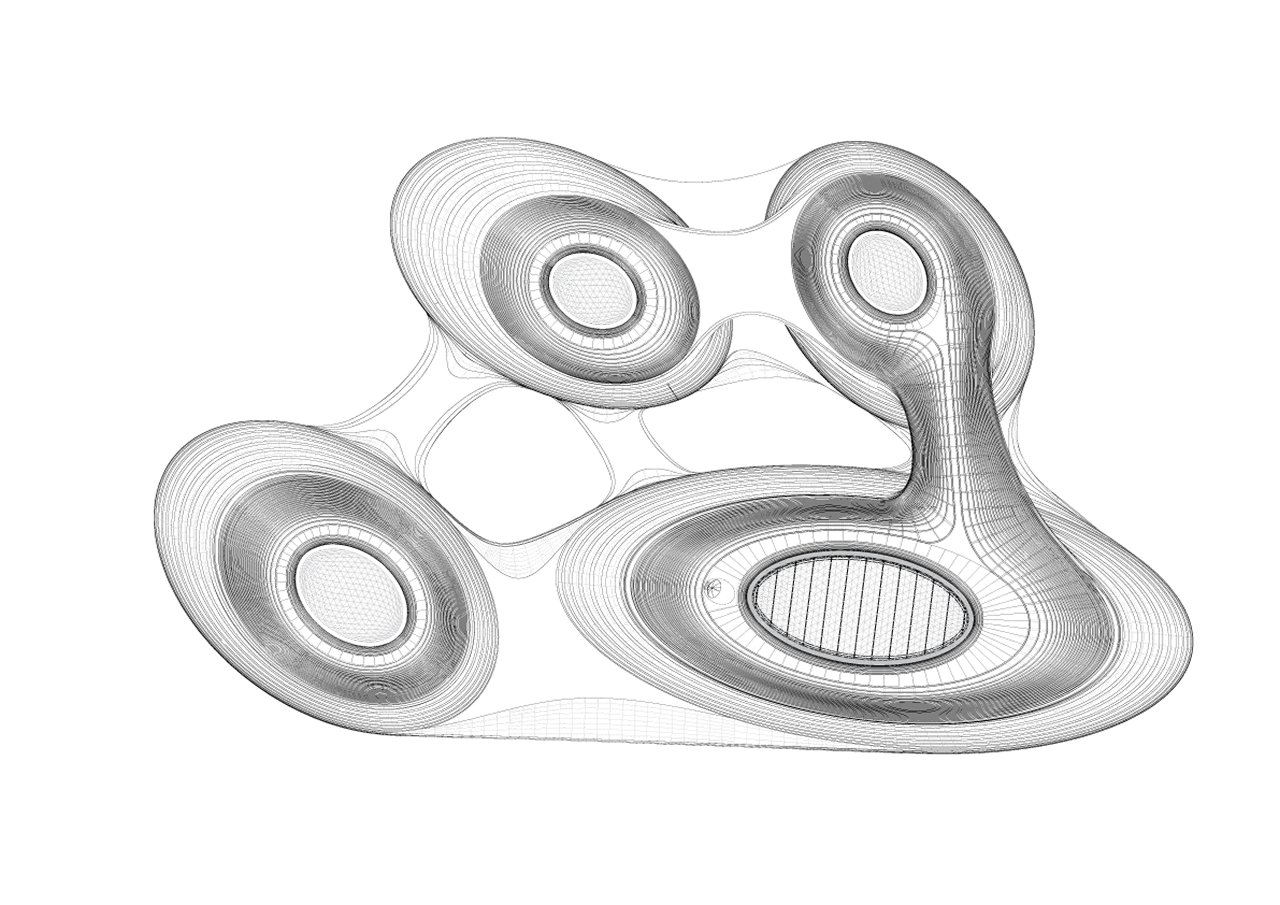
In this system, the "towers" do not exist as separate entities. Instead, four distinct structural volumes fuse together, connected by a series of flowing bridges and plateaus. The design logic draws inspiration from the traditional Chinese courtyard—an internal community space—but updates the syntax for the space age. The result is a continuous internal panoramic experience where the distinction between "floor" and "ceiling" begins to blur.
| COMPONENT | SPECIFICATION |
| :--- | :--- |
| Total Area | 330,000 m² |
| Cladding | Aluminum + Low-E Glass |
| Height | Max 67 Meters |
| Structure | 4 Continuous Volumes |
> MATERIAL_COMPOSITION
The futuristic aesthetic is achieved through rigorous engineering specifications.
The exterior acts as
a skin, wrapping the skeleton in a cohesive shell.
The structure utilizes a reinforced concrete core, but the visual impact comes from the cladding. The building is wrapped in 3mm thick aluminum panels and glass. These materials were chosen for their ability to reflect the changing light of the city and their flexibility in forming complex curves. The layout covers a massive 330,000 square meters, integrating retail and office units into
a single biological organism rather than a grid of boxes.
[VISUAL]: White bands of GRC (Glass Reinforced Concrete) create a rhythmic, topographic effect.
[AMBIENCE]: High brightness, high fluidity
> NAVIGATING_THE_CANYON
How does the user interface with the machine? Inside Galaxy SOHO, the user enters the "Internal Canyon."
Natural light is filtered through the glass ceiling, washing down the curved white balustrades. The walkways facilitate movement similar to liquid flowing through
a pipe. There are no dead ends.
The pedestrian flows connect all four volumes via sky-bridges, creating a sense of immersion. This "Deep Space" aesthetic serves a function: it directs the flow of people naturally, without the need for harsh signage
or restrictive walls. It is an environment optimized for human movement.
> JOIN_THE_NETWORK
> PROTOCOL: OPEN
> Architecture is evolving.
> Do not operate on outdated software.
> ENTER_USER_ID: